The problem
More information needed a better structure.
The SAP Order Management Foundation team had created central screens to hold customer order information and wanted to add more detail. The existing layouts had been built without UX support.
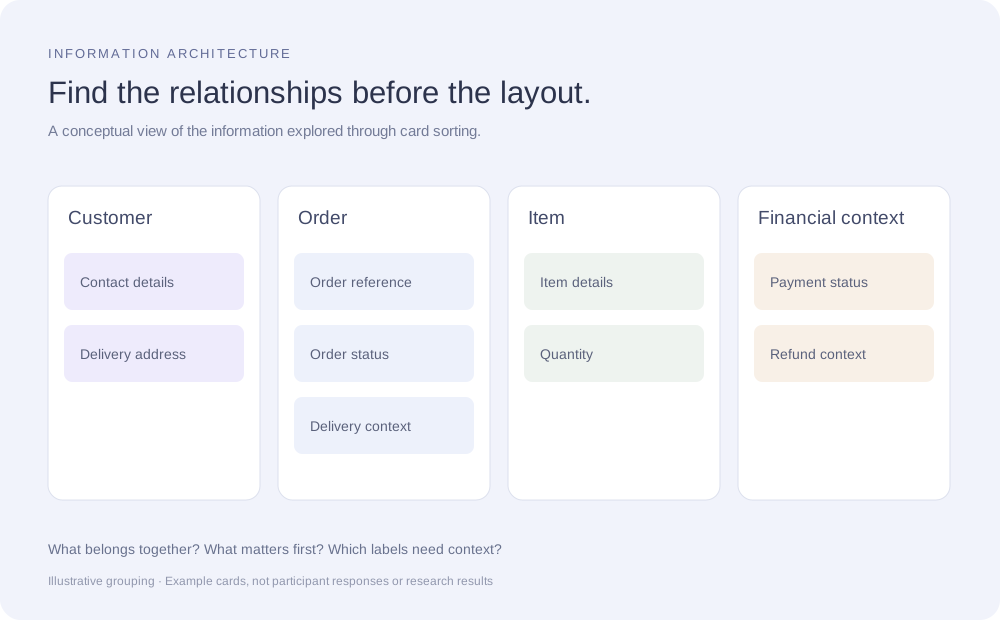
Before expanding those screens, we needed to understand how omni-channel experts grouped and prioritized customer, order, item, and financial data—and whether key information was missing.
Who it affects
Omni-channel experts investigating customer orders.
The work focused on how experts in retail, logistics, supply chain, and e-commerce group and prioritize customer, order, item, and financial information.
Understand the relationships before the layout.
- Which pieces of information do experts naturally group together?
- Which details matter first when investigating an order?
- What information is missing from the existing screens?
- Which labels are unfamiliar or open to interpretation?
I reached out to more than 100 omni-channel experts through LinkedIn Sales Navigator to support recruitment. The research plan targeted professionals in retail, logistics, supply chain, and e-commerce.
Decisions & tradeoffs
Combine groupings with the reasons behind them.
Unmoderated open card sorting
Participants grouped information cards in UserZoom and could suggest missing information. This provided a way to compare organization patterns across responses.
Moderated follow-up sessions
The follow-up discussion explored why participants chose their groups, which information helped them investigate problems, and how that information moved between systems.
I also asked about difficult-to-place cards, unfamiliar terms, and any prioritization within the groups. These questions added context to the sorting patterns rather than treating every grouping as a self-explanatory answer.
An alternative approach I considered and the tradeoff behind combining unmoderated sorting with moderated follow-up sessions.
Progress & learning
From patterns to recommendations.
I analyzed responses from the moderated and unmoderated activities for recurring themes and grouping patterns. Results were compiled in Mural to share with the team alongside recommendations and next steps.
Validate the structure in the actual workflow.
The work provided a basis for reconsidering how order information should be organized. I began exploring screen layouts and coordinating potential changes with development.
The next step described in the original study was usability testing of the existing screens, followed by synthesis with the card-sort findings. The case study does not establish that the proposed layouts shipped or improved a measured task outcome.
Success criteria
The research aimed to understand groupings, information priorities, missing details, and unfamiliar terminology. The original next step was usability testing of the screens and synthesis with the card-sort findings.
The existing case study does not establish that proposed layouts shipped or improved a measured task outcome.
One concrete recommendation from the findings, the task it should improve, and any subsequent evaluation or implementation evidence.